
Maintaining clean air is essential in industries where product quality, employee safety, and contamination control are critical. Pharmaceutical manufacturing facilities, hospitals, laboratories, biotechnology centers, electronics manufacturing plants, and cleanrooms all rely on advanced air filtration systems to create controlled environments. Among the various filtration technologies available today, HEPA filters remain one of the most effective and widely used solutions for removing airborne contaminants.
HEPA filters play a crucial role in reducing particulate contamination, improving indoor air quality, and supporting regulatory compliance in controlled environments. Understanding how these filters work can help organizations make informed decisions when selecting air filtration solutions for their facilities.
What Is a HEPA Filter?
HEPA stands for High-Efficiency Particulate Air. A HEPA filter is a specialized air filtration device designed to capture extremely small airborne particles before they enter critical work areas.
Unlike conventional air filters, HEPA filters are engineered to achieve a filtration efficiency of at least 99.97% for particles measuring 0.3 microns in diameter. This level of performance makes them suitable for applications where maintaining clean and contamination-free air is essential.
HEPA filters are commonly integrated into cleanroom systems, laminar airflow units, biosafety cabinets, fan filter units, HVAC systems, operation theatres, and pharmaceutical manufacturing environments.
Why Airborne Contaminants Are a Concern
Airborne contaminants exist in virtually every indoor environment. While many particles are invisible to the naked eye, they can significantly impact manufacturing processes, research activities, healthcare operations, and product quality.
Common airborne contaminants include:
- Dust particles
- Bacteria
- Mold spores
- Pollen
- Smoke particles
- Fibers
- Aerosols
- Microorganisms
In pharmaceutical and healthcare environments, even small amounts of contamination can compromise sterile conditions, affect product integrity, and create compliance challenges.
How HEPA Filters Work
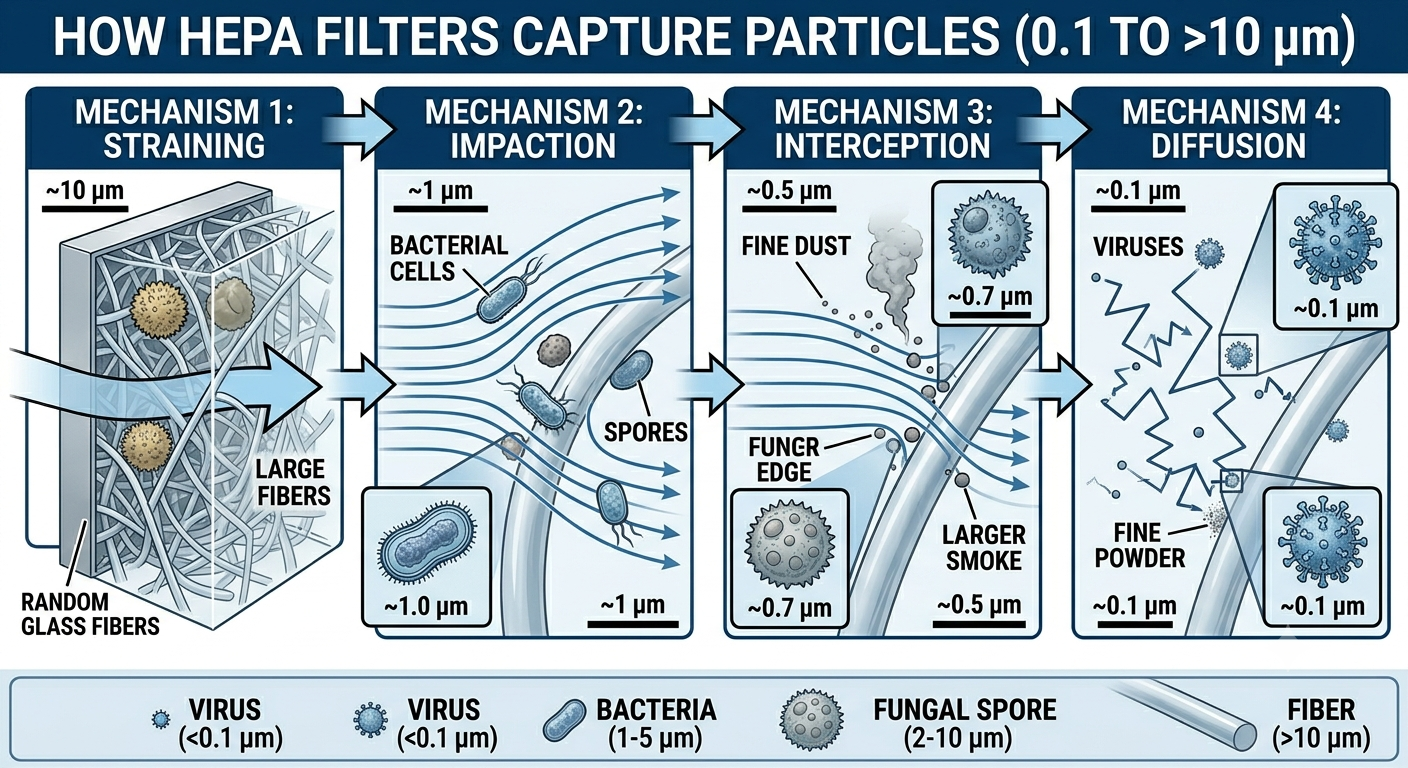
HEPA filters do not function like simple sieves that block particles larger than their openings. Instead, they use a dense network of randomly arranged fibers that capture particles through multiple filtration mechanisms.
As air passes through the filter media, contaminants become trapped before reaching the clean side of the system.
The three primary mechanisms involved in HEPA filtration are interception, impaction, and diffusion.
Interception
Interception occurs when airborne particles follow the airflow stream and come into contact with filter fibers. As the particles pass close to the fibers, they adhere to the surface and become trapped.
This mechanism is particularly effective for medium-sized particles that move with the airflow through the filter media.
Impaction
Larger particles possess greater momentum and cannot easily follow changes in airflow direction around the filter fibers. As a result, they collide directly with the fibers and become captured.
Impaction is especially effective for removing larger dust particles and debris from the air stream.
Diffusion
Very small particles move unpredictably due to collisions with air molecules. This random movement increases the likelihood that particles will contact filter fibers and become trapped.
Diffusion is one of the primary reasons HEPA filters are highly effective at capturing microscopic contaminants.
What Types of Particles Can HEPA Filters Remove?
HEPA filters are capable of removing a wide range of airborne contaminants, including:
- Fine dust particles
- Bacterial contaminants
- Mold spores
- Smoke particles
- Allergens
- Pollen
- Microscopic debris
- Certain airborne microorganisms
Because of their high filtration efficiency, HEPA filters are often used in environments where air cleanliness directly affects operational performance and safety.
Importance of HEPA Filtration in Cleanrooms
Cleanrooms are designed to maintain strict control over airborne particle concentrations. HEPA filtration systems form the foundation of most cleanroom environments by continuously removing contaminants from circulating air.
The use of HEPA filters helps cleanrooms achieve required cleanliness classifications while supporting contamination control strategies. Without effective filtration, maintaining cleanroom standards would be extremely difficult.
HEPA filters are commonly integrated into:
- Laminar Air Flow Units
- Fan Filter Units (FFU)
- HEPA Terminal Boxes
- Operation Theatre Systems
- Positive Pressure Modules
- HVAC Air Handling Systems
These systems work together to create controlled airflow patterns and maintain clean working conditions.
Applications of HEPA Filters Across Industries
Pharmaceutical Manufacturing
Pharmaceutical facilities rely on HEPA filtration to protect products from contamination during production, packaging, testing, and quality control activities.
Maintaining clean air helps support GMP compliance and product quality standards.
Hospitals and Healthcare Facilities
Healthcare environments use HEPA filtration to reduce airborne contamination and improve patient safety.
Applications include:
- Operation theatres
- Intensive care units
- Isolation rooms
- Diagnostic laboratories
- Sterile processing areas
Biotechnology Laboratories
Biotechnology facilities require controlled environments for research, cell culture work, and biological testing. HEPA filters help maintain contamination-free workspaces for sensitive applications.
Electronics Manufacturing
The production of electronic components often requires extremely clean environments because microscopic particles can damage sensitive products.
HEPA filtration helps reduce defects and improve manufacturing consistency.
Food Processing Facilities
Food manufacturers use air filtration systems to improve hygiene and reduce contamination risks throughout production and packaging processes.
Factors That Influence HEPA Filter Performance
Several factors affect the efficiency and lifespan of HEPA filtration systems.
Airflow Velocity
Excessive airflow can reduce filtration efficiency and place additional stress on filter media. Proper airflow balancing helps optimize performance.
Filter Quality
The quality of filter materials and manufacturing processes directly impacts filtration effectiveness and durability.
Maintenance Practices
Regular inspections and maintenance help ensure filters continue performing at their intended efficiency levels.
Environmental Conditions
Dust loads, humidity levels, and operating conditions can influence filter lifespan and replacement schedules.
When Should HEPA Filters Be Replaced?
Over time, HEPA filters accumulate captured particles and gradually become less efficient. Replacing filters at appropriate intervals helps maintain system performance and air quality.
Common indicators that a filter may require replacement include:
- Increased pressure drop
- Reduced airflow
- Higher energy consumption
- Failure to meet air quality requirements
- Visible filter damage
Regular monitoring programs help identify replacement needs before performance issues occur.
Benefits of HEPA Filtration Systems
Organizations that invest in HEPA filtration often experience several benefits, including:
- Improved air quality
- Reduced contamination risks
- Better product quality
- Enhanced workplace safety
- Regulatory compliance support
- Improved operational reliability
- Protection of sensitive processes
These advantages make HEPA filters a critical component of modern contamination control strategies.
Choosing the Right HEPA Filtration Solution
Selecting the appropriate HEPA filtration system depends on several factors, including facility requirements, cleanliness objectives, airflow needs, and regulatory expectations.
Organizations should consider:
- Filtration efficiency requirements
- Airflow capacity
- Application type
- Installation environment
- Maintenance requirements
- Long-term operating costs
Working with experienced air filtration specialists can help ensure the selected solution meets operational goals and industry standards.
Conclusion
HEPA filters are among the most effective technologies available for removing airborne contaminants from controlled environments. Through a combination of interception, impaction, and diffusion mechanisms, these filters capture microscopic particles and help maintain clean air in pharmaceutical facilities, hospitals, laboratories, cleanrooms, and industrial environments.
As contamination control requirements continue to evolve, HEPA filtration remains an essential part of maintaining product quality, workplace safety, and operational compliance. Organizations that invest in reliable air filtration systems can achieve cleaner environments, improved process reliability, and greater confidence in their operations.
FAQ
What does HEPA stand for?
HEPA stands for High-Efficiency Particulate Air.
How efficient is a HEPA filter?
A true HEPA filter captures at least 99.97% of particles measuring 0.3 microns.
Where are HEPA filters commonly used?
HEPA filters are used in cleanrooms, pharmaceutical facilities, hospitals, laboratories, operation theatres, and industrial manufacturing environments.
Can HEPA filters remove bacteria?
Yes, HEPA filters can capture many bacteria and other airborne contaminants when properly installed and maintained.
How often should HEPA filters be replaced?
Replacement intervals vary depending on operating conditions, airflow requirements, and contamination levels. Regular monitoring is recommended.
What industries use HEPA filtration systems?
Pharmaceutical, healthcare, biotechnology, food processing, electronics manufacturing, research laboratories, and cleanroom industries commonly use HEPA filtration systems.